

Two Armenians: Saroyan & Gorky
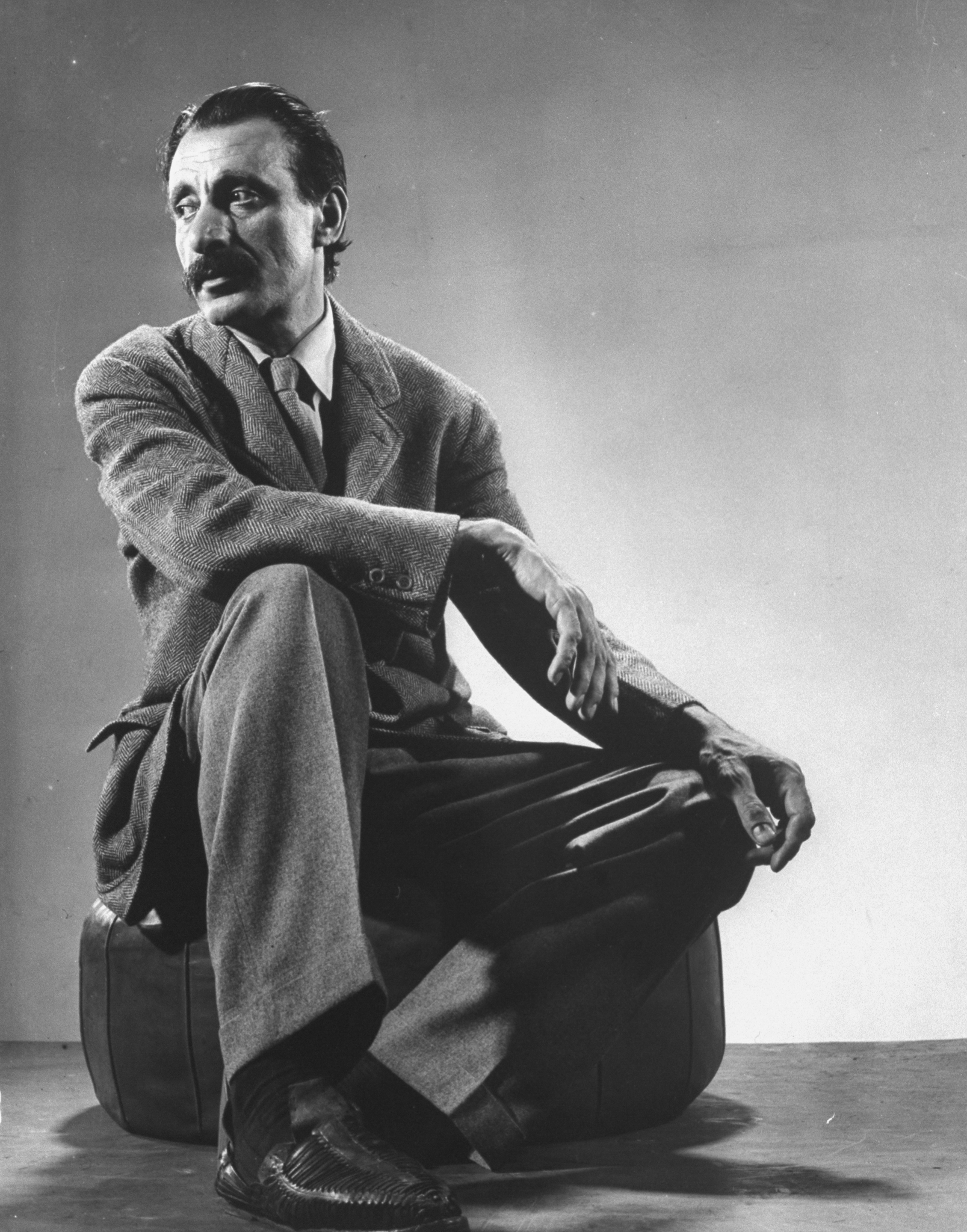 In Saroyan’s famed story “The Armenian & The Armenian” he posits that any two Armenians, when they meet, share so many of the same experiences and collective trauma that they will be like brothers unto one another. This may often be true, but sometimes, just as in actual families, brothers might not get along.
And that describes the relationship between legendary painter Arshile Gorky and legendary writer William Saroyan.
Arshile Gorky was born as Vostanik Manoug Adoian (Ոստանիկ Մանուկ Ատոյեան) in the village of Khorgom (now known as Dilkaya) on the shores of Lake Van. Saroyan’s ancestral hometown, Bitlis, lay roughly 80 miles to the west, ten miles in from Lake Van. His father left Armenia to avoid the draft in 1908, when Arshile was somewhere between the age of 4 and 6. He often relocated the date of his birth, though it could simply be that no one in his immediate family remembered!
With his father in New York, his mother took the family to the city of Van. During the Armenian Genocide, the Adoian family fled to find cover in Russian-controlled territory and returned to Yerevan after hostilities had ended. There, his mother died of starvation. In 1920, he left and came to America, eventually reuniting with his father, though the two didn’t bond in their reunion.
When he came to America, Adoian changed his name to Arshile Gorky. He claimed he was Georgian, and a member of the nobility. He even sometimes claimed to be related to the famed Russian author Maxim Gorky.
In 1923, he entered the New England School of Art in Boston. His paintings were influenced by the Impressionists, and by 1930 his work showed the influence of the post-Impressionists, such as Paul Cézanne. He began teaching at the school, then evenutally moved on to teach at the Grand Central School of Art in New York. There, he would become an essential part of the New York art scene, including interacting with major names in American art like Stuart Davis. In 1935, with the Depression raging, Gorky was empoloyed by the Work Projects Administration’s Federal Art Project. At the same time, he signed a contract wit the Guild Art Gallery and had his first New York solo exhibition. His work experimented with Cubism and Surrealism at the time, making him one of the few Americans recognized as a Surrealist.
By 1935, Saroyan had already exploded across the world of Arts & Letters. In 1934, The Daring Young Man on the Flying Trapeze was published by Story Magazine, and Saroyan’s first collection was released later in that same year. His work was appearing in major magazines, and his antics were covered in the society pages in San Francisco and New York. He was in high demand, and by the end of the 1930s, he had become the best-known Armenian in America.

Along with cinema director Rouben Mamoulian, Saroyan and Gorky were the best-known Armenians in America. Saroyan was always creating art, but was not exhibiting in the 30s and 40s. They lived in different worlds, but at the same time, they had some of the same friends, notably Manuel Tolegian.
Gorky was brought out from New York to California by legendary sculptor Isamu Noguchi. Gorky was heading west to what was supposed to be a solo show of his work at the San Francisco Museum of Modern Art. Things went south for Gorky by the time they reached Los Angeles, but Gorky continued on to San Francisco. There, Tolegian introduced Gorky to Saroyan, though there’s no good record of how that meeting went, though, it was made clear later that the two did not like one another.
The two were different kinds of Armenians. Gorky was born in Armenia, came to the US and made his name in the arts. Saroyan was born in the US to Armenian immigrant parents. They were widely known, both of them rising to prominence at roughly the same time. The difference between the two was their approach to their own Armenianness.
Arshile Gorky felt that William Saroyan was trading on his Armenian identity, that he played it up for the exoticism. This sort of argument has often been made by members of diaspora populations who wish to better integrate into the society they find themselves in. On the flip side, Saroyan believed that Gorky was hiding his Armenianness by changing his name and by claiming to be a Georgian. To some in diaspora populations, this is seen as a denial of their homeland and identity. Adoian had become Gorky, and that was a betrayal in Saroyan’s eyes.
Matthew Spender, Gorky's son-in-law and biographer, covered the tension between the two in his biography of the painter From a High Place: A Life of Arshile Gorky
"Eating at a restaurant one day, Gorky and Mougouch heard a waiter loudly paging the writer William Saroyan. Gorky scowled. He's got a friend to telephone him at the restaurant, he said sourly, just to let us all know he's here. These two Armenian artists knew of each other, and loathed each other, for very Armenian reasons. As it happened, William Saroyan was a close friend of Uncle Aharon's daughter Gail. In later life, he often visited her in the hospital where she worked. He told her that Gorky should never have changed his name or pretended to be a Russian or "Caucasian," or any of that rubbish. Gorky thought exactly the opposite. Saroyan, to him, had made a "career" out of being Armenian. It was worse than imposing his own false standards on the world. It was a kind of theft. Anything in the least bit worldly, any "cashing in" on being an Armenian, was anathema to Gorky."
Despite having changed his name and often claimed he was Georgian, Gorky still held a view as to how an Armenian should act, and be presented. An anecdote told by Willem de Kooning from an interview with Karlen Mooradian illustrates this.
DEKOONING: I saw the play by Saroyan, My Heart's in the Highlands. I may have seen it with Gorky. I asked him about it. He said, "That's not Armenian." I said, "Well, Saroyan is Armenian." Gorky answered, "No Armenian would send his son out to the grocery store to beg for credit. He would go out and beg for credit himself but never send his son." So I never forgot that. It impressed me. You see what I mean. Because I knew Armenians, and when they are together they give it to each other and they're mean. So it had to do with being from over there.
As an artist, Saroyan’s paintings fall squarely in the realm of Abstract Expressionism. His painted works seldom have traditional forms or representative aspects, which are two of the hallmarks of the Abstract Expressionits. While he did have a few paintings shown in group shows, typically those featuring paintings by authors, his artistic output was seldom seen.

Gorky would go on to change the path of American art. Some art historians have called him both the last Surrealist and the first Abstract Expressionist. In the 1940s, he changed to a new style of biomorphic forms. He spent time during that period instructing, and often drinking with, a group of young artists in New York, most of whom had spent time working in the WPA Federal Art project. These included de Kooning, Mark Rothko, Lee Krasner, and Jackson Pollock. By the late 1940s, these artists became known first for their biomorphic forms, which were clearly influenced by Gorky's work, and all later became major figures in the formation and acceptance of Abstract Expressionism. Pollock's early work, such as Totem Lesson I currently in The Anderson Collection at Stanford, shows clear Gorky influence.

Arshile Gorky’s decline started in 1946, and he suffered personal and professional setbacks, all leading up to his suicide in 1948. His work has become known for its influence and is included in many of the most important collections in the world, including the Museum of Modern Art in New York, SFMoMA in San Francisco, the Metropolitan Museum of Art, Tate Modern in London, and the National galleries of Australia, Canada, and the US. He is buried in Sherman, Connecticut. His tombstone reads "Arshile Gorky Adoyan - 1905 - 1948."
